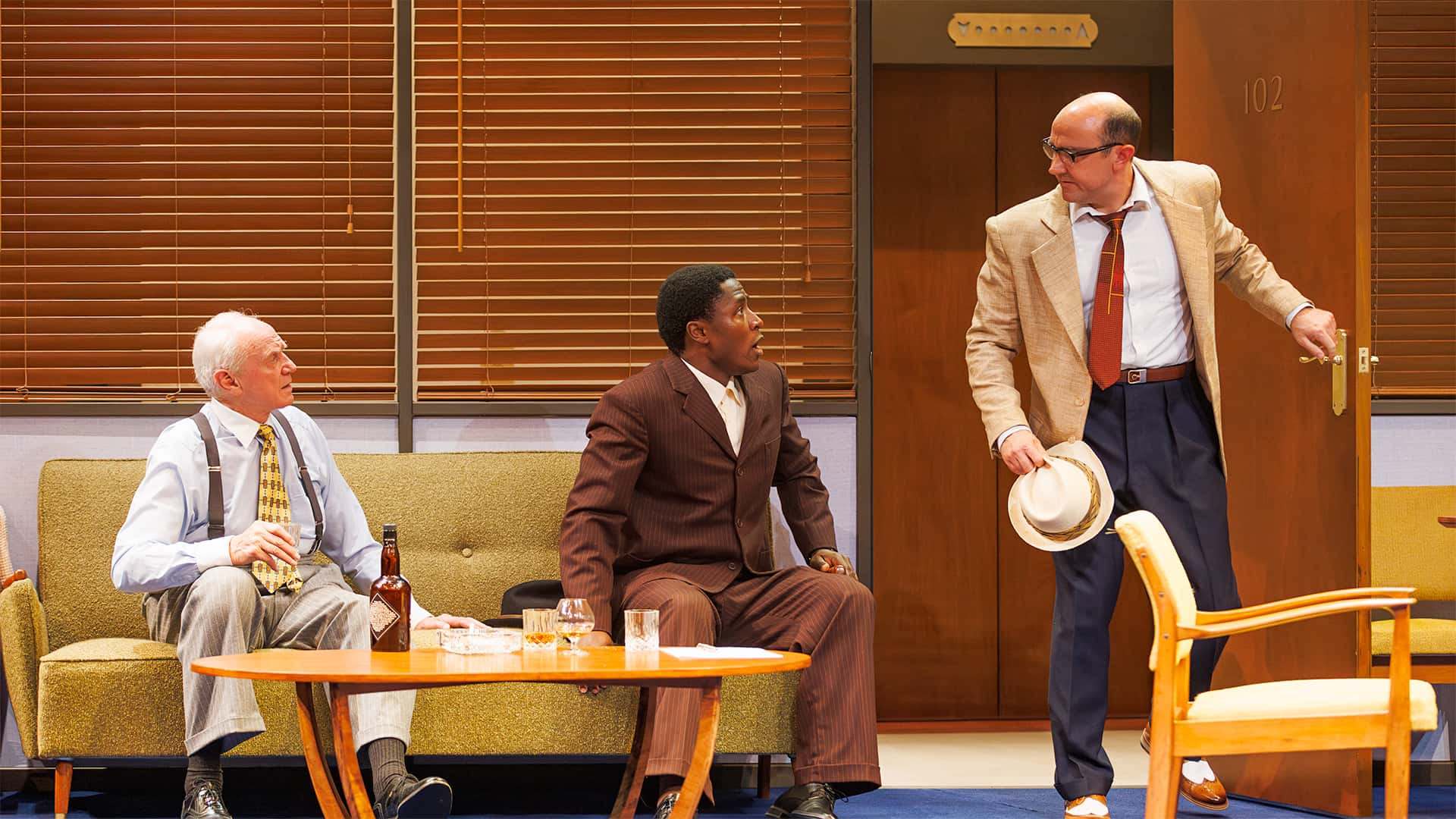
Retrograde by Ryan Calais Cameron is set in a time and place foreign to many of us in Melbourne today: New York City in the mid 1950s, an era of particular political clashes. The play intends to reveal some of the inner workings of show-biz, run as it was by middle-aged white men. Our main focus is a young actor originally from the Caribbean, Sidney Poitier – familiar to some audiences by name (at least, if you are old enough) but maybe not so much by artistic output – on the verge of a securing a meaty lead role. Potentially that all adds up to a lot of conceptual distance for a local audience to traverse when given little help by the text at times. More awkwardly, the play has some quite distracting inconsistencies in its logic, causing this MTC production to feel corralled into being a not-quite-credible tale that leaves us with some unanswered questions.
Cameron’s earlier writings concerned the negative treatment of black men in Britain, and wanting to show characters who were more like the people he grew up with, rather than the usual stereotypes.
Given the author’s interest in writing about disadvantaged groups, he seems well placed to tell this tale of young Poitier pursuing a big break as an industry outsider. The script is based on a true story, although this dramatisation can feel somewhat contrived, with important assertions not interrogated, and credibility stretched as a result.
Notionally, Sidney (Donné Ngabo) is going to the office of a senior lawyer for the NBC TV network, Mr Parks (Alan Dale), to sign a contract to star in a TV film. The script was written by Bobby (Josh McConville) a white man who is Sidney’s long-standing friend and fellow human-rights activist, and who has just inked his part of the deal in view of Mr Parks. Bobby has convinced Parks to let him wait in the office for a minute or two after Poitier’s arrival, just to “settle” the actor into the situation. It’s an odd prelude to what is supposedly a routine administrative exercise.
We would soon learn that the abrasive Parks doesn’t just have power at NBC, he’s accustomed to using that against would-be creatives on NBC projects. Forcing Sidney (Bobby was far more compliant) into a kind of hazing ritual establishes his dominance in the room. We can feel that Parks has his visitors following his script, one designed to improve his chances of getting the deal he wants. Persistent quizzing of Sidney about his activist associations provoked the odd sharp word from the actor, confirming the lawyer’s preconceptions about the risk of this casting choice. Bobby has outstayed his welcome as Sidney learns that there will be some conditions attached to the opportunity on offer. How unfortunate it was that Ngabo had his back to most of the audience at this important juncture.
This is possibly the start of when such curious choices combine with quirks of the dialogue to undermine our belief in the world of the play. An example is when Sidney wants to speak to a lawyer about the contract, and NBC-employee Parks thunders “I am your lawyer” in a manner recalling Colonel Jessep’s “You can’t handle the truth” from A Few Good Men – a mismatch so jarring it is unintentionally comical, showing a preference for dramatic pyrotechnics over realism. It’s one thing for Dale to be a confident senior male in the situation, but as a lawyer, we might have expected more cajoling than brute force, especially as the full stakes of the negotiation, and the importance of getting the deal done, are revealed later. (It also feels quite unwise for a network employee to be so antagonistic towards a star on the rise, one who might well become a high-value asset.) Further, it is unlikely that Sidney, involved in civil rights and able to quote some protections afforded by the US constitution, would accept Parks’ assertion without pushback.
This kind of exchange contributes to a general impression that the play doesn’t give Sidney an emotional arc that coheres with his reported background for vigorous support of civil rights causes and fellow activists. Sitting across a coffee table from Parks, Sidney would regularly hear some accusation or challenge he didn’t like, stand up in angry protest, and then rejoin the unbalanced discussion having cooled almost immediately. This repeating pattern made it difficult to understand why Sidney would remain in this situation without an escalation of his response, or see the game afoot and just leave.
It was also strange that Parks’ vague gesturing towards “American values” (as if this was an inflexible framework shared by all citizens) met no interrogation. There was some mention of how McCarthyism was distorting US politics, but those learning of the show-biz “black list” through the play might not recognise who is setting the “American values” definition, and exactly why they are doing it.
There are other examples of where Parks seems somewhat indiscriminate in his tactics, adding to the feeling of contrivance. He made much of how Sidney pulled out of working on The Pheonix Project. It seems quite overblown to try and make an issue out of an artist’s basic right to choose the work that suits them, and reject what doesn’t – and Sidney had a clear explanation for his decision to walk away. What’s the problem here? It’s another instance where an audience could be distracted from the story by being unclear on the point the script is trying to make.
Other parts of the play could be similarly distracting. Parks was wary of how employing Sidney may affect NBC’s reputation in the current political climate. Partly this is due to the actor’s strong public support for the African-American singer Paul Robeson, a noted critic of American society who had been embarrassing the US government from abroad. Surely that provides a template for someone like Poitier, subject as he was to accusations of being a communist in his adopted country. Why stay in an overtly racist country like the USA when it’s possible to work and apply pressure from overseas? (Of course, Poitier did work overseas in his career, such as in the UK on the 1967 film To Sir, with Love.) We would need the script to give us a little more on Poitier’s motivations to understand this. Similarly, Parks’ advice to Bobby that if he’s blacklisted he’d better get another pen name is the curious combination of a threat with a work-around of the consequences, annihilating whatever impact was intended, and making Parks look more clumsy than powerful.
Ultimately, Sidney makes the choice you would expect of him given knowledge of his background. But, enough cards were on the table early on to suggest that he could have gotten there about 30 minutes earlier. Whilst the acting from Dale and McConville is largely solid (Bobby’s trembling solidarity is another matter), this is Sidney’s story. Ngabo was effective in showing us the demands of being the white person’s idealised black man in his constant effort to be as palatable as possible to the dominant culture around him. We feel the point where he has exhausted himself in trying to maintain that façade. But given the unlikely story elements, those with some familiarity with the US of the 1950s probably won’t feel that they’ve gained much new historical insight. Those with less familiarity might find it necessary to read a few wikipedia entries to get a better sense of the actual story, and a clearer understanding of burdens borne by people of colour in 1950s America.
Event details
Melbourne Theatre Company presents
Retrograde
by Ryan Calais Cameron
Director Bert LaBonté
Venue: Fairfax Theatre, Arts Centre Melbourne VIC
Dates: 16 May – 27 June 2026
Bookings: www.mtc.com.au